Live reviews
Apply Vetra to active systematic review, scoping review or rapid review projects.

Design, search, screen, extract and write with specialised AI agents, while every decision remains documented and validated by the researcher.
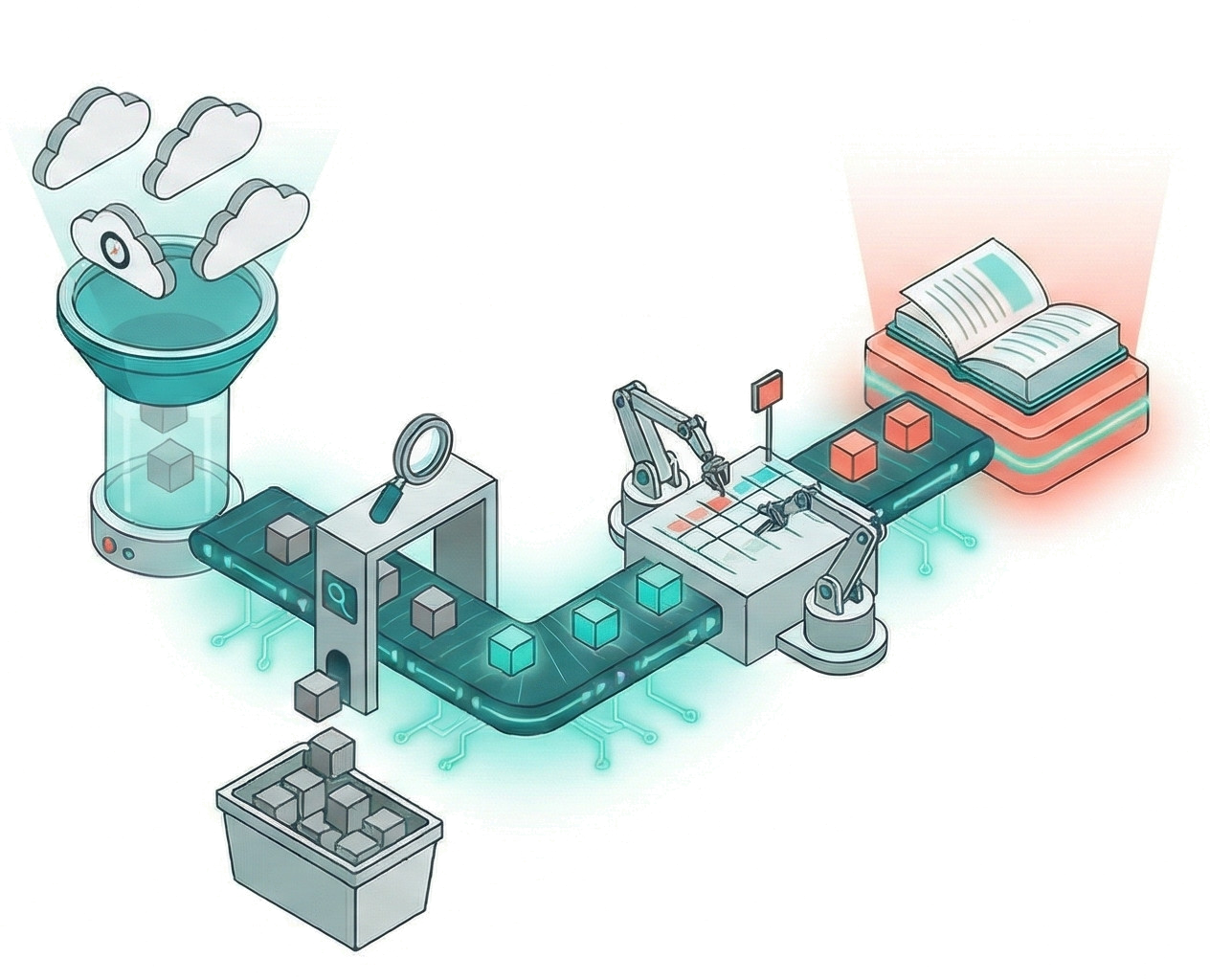
A health systematic review often means months of manual work: designing the search strategy, replicating it across multiple databases, screening hundreds or thousands of references, applying quality checklists, extracting data and drafting the final report.
Searches and the first screening pass alone can take weeks of dedicated work.
Highly qualified research time is spent on repetitive tasks.
Lack of time, different guidelines and the absence of a common standard increase the risk of inconsistent decisions.
When new evidence appears, repeating the process is almost as costly as starting from scratch.
An AI tool designed specifically to support the researcher step by step through every review stage, combining smart automation with human control and robust methodology.
Reduces months of work to a few hours of effective effort.
Built on recognised guides such as Cochrane, JBI and Campbell; reported according to PRISMA guidelines and aligned with RAISE principles for responsible AI use.
Allows several researchers to work in parallel, with blinding when needed.
The AI suggests, prioritises and automates, but the final decisions always belong to the researcher.
From question formulation to results synthesis and report writing.
Through a conversational flow with the AI, the researcher structures the question, review design, selection criteria, secondary objectives, time frame, languages and study types.
See how the protocol is designedVetra suggests terms from the full review design, combines thesauri and keywords, adapts syntax to each database and keeps the queries consistent.
See how the search is builtVetra screens and classifies records with the full review design in mind, first by title and abstract and then by full text, justifying each decision and its confidence score.
See how screening worksThe tool guides the use of recognised checklists by study type, such as Cochrane, QUADAS, JBI and others, recording answers and judgments in a structured way.
See how risk of bias is assessedVetra performs data extraction in a structured way, taking the review outcomes into account and referencing each note in the original paper.
See how data are extractedIt supports results synthesis, tables and figures following GRADE methodology when appropriate, always with final review and interpretation by the researcher.
See how results are synthesisedIt helps prepare drafts, methodological sections and supporting text from documented decisions, without replacing authorship or critical review by the researcher.
See how writing is supportedDesigned for teams that need to carry out systematic reviews rigorously, but cannot afford endless and inefficient processes.
Health science researchers that carry out systematic reviews as part of their scientific work.
Nursing or medical units that research to improve evidence-based clinical practice.
Organisations that develop clinical practice guidelines and need to synthesise evidence systematically.
Master's and doctoral students who carry out systematic reviews as part of their training and research.
It is not just a search tool or an AI chat: it guides the review from start to finish, keeping the full context in view at all times, as a researcher would.
Every decision is documented: what the AI suggested, what the researcher accepted or changed and under which methodological criterion.
Designed from clinical and research practice, not just from engineering.
Built so the outputs can be published in scientific journals, not just used as guidance.
Vetra is already live and we are onboarding the first teams to use it in real reviews, with methodological support and usage metrics collection.
We are selecting universities, hospitals, scientific societies and research groups to test Vetra in live reviews.
Apply Vetra to active systematic review, scoping review or rapid review projects.
Support throughout design, search, screening, analysis and drafting.
Measurement of time saved, traceability, screening precision and methodological record quality.
Structured records for PRISMA, methodological audit and AI-use disclosure.
We want teams to work faster, keep stronger traceability and maintain a consistent experience across the review process.
Programme for scientific societies, universities, hospitals and health research groups.
Request pilotFull PRISMA workflow coverage: question, search, screening, quality, extraction and synthesis.
Modules to help formulate hypotheses and study designs from synthesised evidence.
Support for manuscript writing, integration with ORCID, reference managers and possible institutional review marketplaces.


Co-founder and CEO
Strategy, scientific validation and business development
Nurse specialist in Family and Community Nursing, master's degree holder in ulcers and wounds, and PhD candidate. He leads Vetra's strategic vision, alignment with the real needs of researchers and institutions, and the platform's methodological validation.

Co-founder and CTO
AI, product and technical architecture
AI engineer specialised in turning advanced models into operational solutions. He leads Vetra's technology architecture, AI agent development and the transformation of the prototype into a robust, reliable and usable product.

Co-founder and COO
Operations, cloud and industrialisation
Engineer and consultant specialised in cloud solutions for telecommunications. He coordinates Vetra's operational execution, cloud infrastructure and the processes needed to turn the platform into a secure, stable solution ready to scale.
Vetra is built on the combination of three core capabilities: applied artificial intelligence, research methodology rigour and technical execution. Carlos leads the AI and product architecture; Fernando connects the platform with the real needs of researchers, reviewers and institutions; and Javier makes sure the solution can operate securely, stably and with room to grow.
This combination lets us go beyond an AI demo: we are building a platform designed to accelerate real systematic reviews while preserving traceability, methodological rigour and technical feasibility.
We are looking for strategic partners and organisations with whom to validate and scale Vetra. If you are interested in exploring how Vetra can help your university, clinical service or scientific society, we would be glad to talk.